Small co-ownerships: what the new regulation changes for your maintenance log
Analysis of the new requirements applicable to small co-ownerships regarding the maintenance log

News
With the coming into force of the Regulation establishing various rules regarding divided co-ownership (D. 991-2025 G.O. II) on August 14, 2025, all syndicates of co-ownership will be required to have established a maintenance logbook within three years at the latest, that is by August 14, 2028.
The maintenance logbook is used in particular to plan and monitor the work required to ensure the preservation of the immovable. It must be prepared by an authorized independent professional (architect, engineer, certified appraiser, or professional technologist), updated by the syndicate’s board of directors at least once a year, and reviewed in due time by an authorized independent professional.
Section 5 of the Regulation provides that such a review of the maintenance logbook must be carried out at least every five years. However, it may be carried out at least every ten years when one of the following conditions is met:
-
The immovable consists of no more than eight private portions, excluding accessory portions such as storage or parking spaces
-
No common portions of the immovable are located within a building, that is horizontal co-ownership
-
The immovable has no more than three storeys entirely above ground
CALCULATION OF THE NUMBER OF STOREYS UNDER SECTION 5 OF THE REGULATION
With respect to this third possibility, the Regulation does not define what must be considered a “storey.” We therefore deemed it useful to examine the meaning of this provision more closely.
According to the Québec Construction Code:
-
A “storey” is defined as the part of a building between the top surface of a floor and the top surface of the floor immediately above it
-
The first storey is the highest storey whose floor is no more than 2 m above the average ground level. It is important because it serves as the reference for determining building height under the Québec Construction Code
-
Average ground level (grade) is the lowest of the final average ground levels measured along each exterior wall of the building facing a street
If the floor of the private portions on the ground floor is less than 2 m above ground level, any private portions located below the ground floor are considered to be in the basement. Under the Construction Code, a basement is not considered a storey. Under the Regulation, a basement is not a storey entirely above ground. A co-ownership building with three storeys above ground and private portions in the basement would therefore contain four stacked private portions. Based on our understanding, such a co-ownership could have its maintenance logbook reviewed every ten years.
However, if the floor of the first storey above ground is located more than 2 m above ground level, the level below that floor is not considered a basement under the Construction Code, but rather the first storey. In that case, under the Regulation:
-
If the first storey is not entirely above ground, it is not included in calculating building height. Such a co-ownership may have its maintenance logbook reviewed every ten years
-
If the first storey is entirely above ground, it is included in calculating building height. Such a co-ownership must have its maintenance logbook reviewed every five years
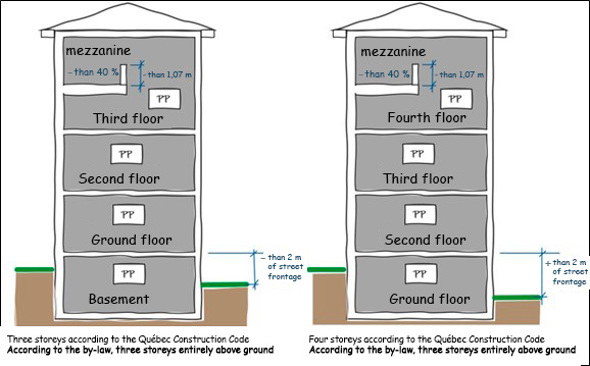
The diagram above highlights the main aspects of the maintenance log in co-ownership.
This diagram is the property of the firm Cossette Touchette,
Certain mezzanines are also not considered storeys. The Construction Code allows the space above a mezzanine not to be considered a storey in calculating building height, provided that:
-
The cumulative area of the mezzanine does not exceed 40 percent of the open floor area of the room in which it is located
-
The space above the mezzanine floor is not divided by partitions or walls higher than 1070 mm. However, this space may include an enclosed area whose floor area does not exceed 10 percent of the open floor area of the room containing the mezzanine
The Regulation does not address this situation specifically. However, it is clear that a mezzanine built in accordance with these criteria is not considered in calculating building height.
To facilitate understanding, we have prepared the diagrams above, which illustrate these different scenarios.
INFO
The article and diagram were produced with the collaboration of the firm Cossette Touchette, contributor to the content. The article was written by Richard Lecouffe, in partnership with Condolegal, based on the practical guide published on their website.
We invite you to consult the other detailed sub-sheets directly on Condolegal’s website or by scanning this QR code:

Login to view this content
Become a member
Access all our services and a vast network of experts by becoming a member of the RGCQ.